Collective care is at the heart of global intersex movements built around solidarity and community

We caught up with Astraea Intersex Human Rights Fund (IHRF) Senior Program Officer, Ruth Baldacchino, and Program Associate, Loé Petit, to find out more about how intersex communities have been impacted by the pandemic, how they’re adapting their work to best serve their communities in this changing world, and what they need to see them through.

Astraea’s blog, Collective Care Blog: Building the Power & Resilience of LBTQI Movements Now & for the Long Haul, is Astraea’s response to the global COVID-19 pandemic. As a feminist LBTQI funder, we believe it is our responsibility to shed light on the ways our communities are particularly impacted by the crisis, share insights around the criticality of healing justice and collective care, as well as the ways in which we’re digging deep to keep shifting power to the grassroots in meaningful and sustainable ways.

***

Everything people are doing to take care of the community can be seen as healing justice or collective care and this work has been part of the practices of the intersex movement since its very beginning. It is the very reason the intersex movement was born in the first place.

– Loé Petit, Intersex Human Rights Fund Program Associate

On November 8, we commemorated Intersex Day of Solidarity, an annual day of remembrance during which we reflect on the ongoing struggles of the global intersex community. This year in particular, the global intersex community—like so many other marginalized communities around the world—has been deeply impacted by the COVID-19 pandemic and its ongoing knock-on effects. From financial hardships to isolation from their chosen communities, intersex people and the growing global intersex movement are experiencing numerous challenges to their ability to survive, organize, and thrive. Yet simultaneously, intersex organizations have continued tirelessly to look out and provide for each other, from building critical online community spaces to setting up mutual aid networks.

As the pandemic continues to rage across the globe, intersex organizations—which are already amongst the most vulnerable in terms of their access to resources and support—need sustained, flexible funding to be able to grow and build power for their movements and themselves. We caught up with Astraea Intersex Human Rights Fund (IHRF) Senior Program Officer, Ruth Baldacchino, and Program Associate, Loé Petit, to find out more about how intersex communities have been impacted by the pandemic, how they’re adapting their work to best serve their communities in this changing world, and what they need to see them through.

[This interview has been edited for clarity and length.]

How have intersex organizations and movements had to adapt their strategies to meet the COVID-19 moment?

Loé Petit: All our grantee partners have had to adjust their strategies and activities. A lot of groups have shifted a lot of their work online to try and create a sense of community in the face of restrictions on movement. OII Europe for example started a series they are calling “Camp Fires” where intersex community members and activists come together to watch movies together and then discuss them. Other grantee partners who regularly provide peer support or family support have moved those activities online. Additionally, while many groups have moved online, groups like the Intersex Community of Zimbabwe have been physically going to rural areas to do trainings around making hand soap and hand sanitizer. In Asia, many of our grantee partners have been providing mutual aid support through either direct donations to those in need and/or supplying food.

Ruth Baldacchino: The main takeaway of all this is that everyone has been impacted and people are not only having to change their strategies but also—like us—shifting the way they work, where they work, how to engage with their members or with other community members. Many have also repurposed their grants, shifting that money from support to the organization to buying, as Loé said, food packages and supporting community members even with temporary accommodations, and medical and other basic supplies. 

Can you tell us a little bit more about how the pivot to primarily online work has been for intersex groups?

RB: Yeah, so even pre-COVID different groups engaged with their members differently; they had different strategies. Some were already doing a lot of online work and they were connecting with other members or other intersex organizations via social media and online, others were doing more community work, going into towns and villages to reach out and support families.

Existing infrastructure challenges play a critical role in this: those who did not have the best access to the internet are still facing those challenges, and in some cases they’ve worsened. It’s also a bit early to determine the long-term impact and shifts. In the first few months, people were really addressing the emerging and very urgent needs like access to food and other supplies, and if this goes on longer I think groups will be continuing to rethink and rework their campaigns and their strategies.

LP: Yeah, I agree. When we talk about shifting to online campaigns, it really depends on the capacity and local infrastructure that is available. In some regions, like parts of Africa and Latin America, it makes things much harder, while in other regions—especially for those not living in big cities—shifting online has in some cases allowed people to gather more easily because more people can join from their homes.

How have intersex activists and organizers been specifically impacted by the restrictions on movement as a result of the pandemic?

LP: One of the first things that comes to mind is the postponement of the 5th International Intersex Forum which was originally scheduled to take place in March of 2020. This year would have been the first international forum since 2017—and the movement has grown and changed a lot since then—and its postponement has had a real impact on intersex movements’ morale as well of course as their capacity building. The forum eventually took place as an online conference from September 30 – October 26, 2020, which was obviously very different than having it in person because while the conference part of the forum is important, it is usually in those other moments, when organizers get together socially and more informally and meet as human beings that connections are really formed. And I would say this is especially important in the intersex community because there are still such few spaces where intersex people can gather and meet.

As I’ve said previously, shifting to online meetings is sometimes more inclusive because it allows those who have less mobility to take part as well. But moving online shifts the focus of these meetings to be centered around political activism work, and doesn’t allow for as much trust building between humans. So I think that could have an impact on the capacity of the grantees to build stronger regional networks, and especially with new people. It becomes especially difficult for a newer generation of activists to get involved, because the regional in-person meetings are also a way to learn from and meet more experienced activists.

RB: I agree, and one of the things that we’ve always argued as a fund and as Astraea, is the need to support the creation of spaces, physical spaces. We’ve built a lot of our work around supporting those spaces, whether it’s the regional meetings, other capacity building work, or the forum. As someone who’s been in those spaces for many years, I could see the huge impact they have had on the movement. We’ve seen declarations, consensus statements coming out from the movement. We’ve seen organizations being formed. We’ve seen agreements and disagreements as well, but that’s how movements emerge. This restriction of movement is significant.

Additionally, these spaces have also become incredibly important for donors. Donors wait to see the outcomes and the key decisions that are made in these meetings. So this also impacts our work as a fund, as a donor. We’ve all built our work around movement, literally moving. For me as a program officer, the conferences and those spaces were always an opportunity to connect, form friendships, and get to understand the intersex activist landscape better.

What has the impact of all this meant for intersex organizations’ ability to do advocacy work?

RB: A lot of the advocacy has stopped or slowed down because people aren’t able to be at the institutions where that work is usually carried out, whether those are regional human rights institutions, or international ones, like the UN. This is of course not just an intersex movement issue. This is a big concern because advocacy strategies are important, they build on past work, they build on connections, on networks, on being in the same physical space as the policymakers and the governments. So it’s difficult to imagine what this means, for activists to not be able to be in New York or in Geneva and keep that momentum, to have human rights mechanisms and treaty bodies really listen to intersex people directly when they’re reviewing countries, when they’re making recommendations. 

Shifting gears a little bit, can you speak about the economic impacts of the pandemic for intersex people and movements?

LP: So at the moment of course we don’t have enough quantitative data, but what we do know as I’ve mentioned is that in general people in more informal sectors and non-traditional sectors—which many intersex people are a part of—have been badly affected. Beyond this, I think it’s important to name the ways in which some funders have shifted their priorities and the impact that is having on intersex organizations.

RB: Yeah, what we saw as well as what grantees have reported, was some donors shifting priorities and sometimes also reducing funding for LGBTQI programing and shifting it to development or humanitarian aid as the pandemic hit. That was very worrying because that happened instantly with some funders. It didn’t allow groups to plan or to find other sources of funding to mitigate the effects, and that is still a concern. As donors that’s definitely on our mind.

Following up on that, what do you believe Astraea and the IHRF’s specific role is through this pandemic, both from the perspective of supporting intersex grantees, but also in terms of advocating for more intersex funding with other donors?

RB: Primarily what we started noticing earlier this year when the pandemic began spreading throughout the world and we started learning more about its impacts, was that intersex people were not being mentioned anywhere. They were absolutely missing from all the conversations that donors were having around the impacts of COVID-19. Even within LGBTQI donor spaces, as we were shifting our work to online meetings, trying to understand how to react and support our grantees in this pandemic, intersex people were missing from the conversation. So that has definitely been a big part of our role, to create donor spaces to specifically discuss intersex issues and to share with other donors what we’re hearing and learning from our grantees. That’s always been our role as a fund, but this year it’s particularly important.

In these spaces, we share a lot of what we’ve just discussed and we highlight—as we always have—the need for flexible funding. I think the pandemic really reinforces that need. Because of the flexible funding we provided, grantees were in a position to shift their programming, to shift their grants to buy food, provide shelter and accommodation. If that funding was restricted funding, they wouldn’t have been able to do that. And I think hopefully this year should have been a clear reminder to funders that flexible funding is the only way to support movements and intersex organizations. That remains our key message because of all these emerging issues and challenges, flexible funding is the only way to support a movement sustainably and on a longer term.

Finally, how do and how have intersex organizations incorporated healing justice and collective care strategies into their work and activism?

RB: In some ways, this is a question of how we frame healing justice and collective care strategies in relation to intersex movements. For intersex communities and movements, addressing trauma through different strategies and approaches has always been one of the ways that intersex organizations have practiced collective care and healing justice.

LP: I think the work of intersex organizations has really always been about centering community. So when I spoke about OII Europe organizing ‘Camp Fires’ to keep up the morale, that’s community care. And when I spoke about Intersex Community of Zimbabwe delivering trainings on how to make soap and sanitizer, that’s community care. Everything people are doing to take care of the community can be seen as healing justice or collective care and this work has been part of the practices of the intersex movement since its very beginning. It is the very reason the intersex movement was born in the first place.

***

Want to read more from our Collective Care Blog? Follow us on Facebook, Twitter, or Instagram to stay up-to-date on the latest posts!

Celebrating Bi Visibility Day

This Bi Visibility Day, we are proud to celebrate vibrant and powerful bisexual communities around the world.

Astraea’s blog, Collective Care Blog: Building the Power & Resilience of LBTQI Movements Now & for the Long Haul, is Astraea’s response to the global COVID-19 pandemic. As a feminist LBTQI funder, we believe it is our responsibility to shed light on the ways our communities are particularly impacted by the crisis, share insights around the criticality of healing justice and collective care, as well as the ways in which we’re digging deep to keep shifting power to the grassroots in meaningful and sustainable ways.

***

by Sabrina Rich, Communications Team

This Bi Visibility Day, we are proud to celebrate vibrant and powerful bisexual communities around the world. Lesbian, bisexual, and queer (LBQ) women and non-binary people* are not only creating change in all aspects of their own lives, but are also building a new political reality that is inclusive, respectful, and safe for all communities. Alongside lesbian, trans, and queer people, bisexual women and non-binary people are activists, movement leaders, and advocates for their communities. 

LGBTQI communities are beautiful and diverse. Treating a group of people who face vastly different experiences as a monolith is harmful for all members of the community. Bi Visibility Day is significant because it celebrates a group within the LGBTQI community that is often ignored. Bisexual people frequently experience homophobia, but they also face discrimination from their lesbian and gay peers. The notion that “bisexuality is not real” is common, and is regularly perpetuated by folks within and outside of the LGBTQI community. Bi Visibility Day is a necessary reminder that bisexual people are real, whole, complex human beings whose identities are deeply valid.

Acknowledging the unique realities of bisexual communities is important not only for combatting such discrimination, but also for providing tangible support to bisexual communities. The impacts of biphobia include discrimination in workplaces, housing, and healthcare. Celebrating Bi Visibility Day also means acknowledging these issues and working to support bisexual communities in their fight for justice.

Bisexual women and non-binary people, along with their lesbian and queer peers, face violence, discrimination, and exclusion everyday around the world. Earlier this year, Astraea released our report, Vibrant Yet Under-Resourced: The State of Lesbian, Bisexual, and Queer Movements. This report presents findings on the state of lesbian, bisexual, and queer (LBQ) movements around the world based on surveys conducted in 2018 with 378 LBQ groups from all regions of the world and 67 donors, including public and private foundations, as well as follow-up interviews resulting in four case studies of LBQ groups. Through our research, we found that:

  • LBQ groups are young and quickly growing in numbers. 
  • LBQ groups work in intersectional ways.
  • LBQ groups utilize multiple robust organizing strategies to achieve their aims.

LBQ groups are doing necessary, meaningful work to build powerful movements and create lasting change, but they lack the proper funding. Our research also found that:

  • LBQ groups have extremely small budgets and very little access to external funding. 25% of groups reported having a non-existent or zero annual budget, and 40% of LBQ groups reported having a budget of less than $5,000
  • LBQ groups receive insufficient support to fully implement their strategies. Fewer than one in four groups using advocacy, community and movement building, and capacity building — the three most common strategies — reported receiving sufficient funds for their planned activities.*

The lack of funding that LBQ groups receive speaks to the erasure of queer women and non-binary people from LGBTQI and women’s funding spaces. General LGBTQI and women’s funding often fail to reach LBQ women and non-binary people, who sit at the intersection of these identities. 

Bisexual women and non-binary people are on the frontlines, fighting back against the various oppressions they face. Bisexual communities around the world are working to dismantle systems of homophobia, transphobia, patriarchy, white supremacy, and capitalism, and it is our responsibility to fuel these grassroots movements. 

It is an unfortunate reality that data and research focusing specifically on bisexual women and non-binary people is rarely conducted and difficult to come by, despite these communities facing unique challenges. While our report includes useful findings and recommendations for funders looking to support LBQ movements generally, we have included some resources below that pertain more directly to understanding bisexual communities and their needs. 

* Astraea focuses on bisexual women and non-binary people rather than men because we recognize that these groups face disproportionate discrimination globally, including exclusion, violence, lack of legal protections, and lack of access to health care, education, and employment, along with lesbian, queer, and trans women and non-binary people.

* For our full list of key findings and donor recommendations, visit FundLBQ.org

***

Want to read more from our Collective Care Blog? Follow us on Facebook, Twitter, or Instagram to stay up-to-date on the latest posts!

For trans communities, collective care is critical to safety and survival

In this blog post, we spoke to our Program Officers, Mariam, Lame, and Brenda to better understand some of the specific ways our trans grantees and their communities have been and continue to be affected by the COVID-19 pandemic and its economic, social, and political fallouts.

Astraea’s blog, Collective Care Blog: Building the Power & Resilience of LBTQI Movements Now & for the Long Haul, is Astraea’s response to the global COVID-19 pandemic. As a feminist LBTQI funder, we believe it is our responsibility to shed light on the ways our communities are particularly impacted by the crisis, share insights around the criticality of healing justice and collective care, as well as the ways in which we’re digging deep to keep shifting power to the grassroots in meaningful and sustainable ways.

***

A global pandemic was always going to have a disproportionate and devastating impact on trans communities around the world. As communities that already face systemic discrimination and violence, are often unable to access healthcare, housing, and economic opportunities, and whose human rights are either at grave risk or denied entirely in several countries, trans people have been marginalized time and time again. So, as the COVID-19 pandemic hit countries around the world in the Spring of 2020, it became clear that trans communities could feel some of the worst impacts of the crisis. In a United Nations statement in April 2020, UN High Commissioner for Human Rights, Michelle Bachelet said, “LGBTI people are among the most vulnerable and marginalised in many societies, and among those most at risk from COVID-19. In countries where same-sex relations are criminalised or trans people targeted, they might not even seek treatment for fear of arrest or being subjected to violence.”*

In this blog post, we spoke to our Program Officers, Mariam, Lame, and Brenda to better understand some of the specific ways our trans grantees and their communities have been and continue to be affected by the COVID-19 pandemic and its economic, social, and political fallouts. We also share the innovative, creative, and care-driven ways our trans grantee partners and other grassroots LBTQI groups have been providing critical mutual aid to their people and bringing their communities together – despite not being able to be together physically.

Mariam remarked, “It is astounding to see the ways in which our trans grantees have immediately stepped up to care for their communities. But we have to acknowledge the immense burden on them – the pressure from funders to respond effectively to the situation, to respond to the needs in the community that are really overwhelming as we’re seeing from human rights documentation, to be accessible online to community members 24/7, and to continue their advocacy – all while experiencing the same challenges as everybody else.”

*Michelle Bachelet, COVID-19: Targeted actions needed to protect LGBTI people amid pandemic 

—

How trans grantees are caring for their people and creatively building community in the midst of this crisis:

  • Gender Dynamix (South Africa) have been working in partnership with a number of trans organizations from throughout the Southern African region to host a podcast shedding light on the realities of trans communities during this time. 
  • A grantee partner in Kenya has been supporting trans people without access to shelter, particularly trans refugees arriving from Uganda
  • Queerabad (India) have been providing mental health resources and support to their communities through their online platforms
  • Nazariya (India) created zoom hangouts for community members, to unpack the impact of COVID-19 on queer women and trans* folks, bringing to light the challenges of being forced to stay home with family members who do not support LGBTQI issues. 
  • Trans*Coalition (based in the Former Soviet Union countries) started a regional COVID-19 response campaign including a fundraiser, emergency response and critical analysis on the impacts of the pandemic
  • TransAkcija (Slovenia) created an online Pride Month celebration when physical celebrations were canceled and led anti-government protests against fascism and mismanagement of the pandemic
  • Zagreb Pride (Croatia) launched an online campaign against the government’s use of surveillance technology to track the movement of citizens, and succeeded in their efforts!
  • Caribe Afirmativo (Colombia) have been providing mutual aid to sex worker communities in Colombia and supporting them to find work
  • TransWave and WE-Change (Jamaica) formed a consortium with larger LGBTQ organization J-Flag to raise funds specifically for LGBTQI communities impacted by the COVID-19 pandemic.

How has COVID-19 along with restrictions on movements directly impacted trans communities?

Lack of access to healthcare: 

  • Trans people already have unequal access to healthcare facilities, putting them at greater risk if they contract the virus. For incarcerated trans people for whom social distancing is near impossible and access to PPE is limited at best, this risk is greatly increased
  • Many trans people going through hormonal therapy – whether utilizing formal or informal healthcare channels – have struggled to access it as a result of lockdowns and slowdowns in mail services etc.
  • Gender-affirming surgeries were/have been postponed indefinitely in many countries to prioritize patients with COVID-19
  • Mental health of trans communities has suffered during the pandemic for a number of reasons from fear of contracting the virus without adequate access to healthcare facilities, to dealing with violence and transphobia as a result of being forced to isolate in unsafe environments

Loss of livelihood:

  • Many trans people work in service industries around the world, which have been some of the hardest hit, and have lost their jobs as a result of ongoing economic crises
  • Trans sex workers have either been forced to drastically cut down on work or stop working altogether as a result of restrictions on movements, and to protect their own health and safety
  • In many parts of the world, trans people work in informal sectors or in part-time positions where they have to ‘hustle’ to get work and negotiate wages. This often means needing to be physically out in marketplaces and communities in order to secure that work and perform it, which has been difficult or impossible as a result of lockdowns  

Housing:

  • Many trans people have been forced to isolate in unsafe environments with family members or others who reject or denounce their identities, and are violent towards them as a result. 
  • As a result of loss of income and an inability to pay rents, many trans people have been evicted or forced to leave their homes

Discrimination and violence

  • Legislations restricting freedom of movement have given police and military forces in several countries the authority to exercise undue power and act with impunity in many cases. Trans people – and especially trans sex workers – who are already often subject to discrimination and violence by the state have been disproportionately targeted
  • Limited access to movement has made it harder for trans people to organize and practice dissent against harmful laws and policies. Coupled with the general public’s preoccupation with the pandemic itself, some governments have used this period as an opportunity to ‘quietly’ roll back rights for trans people or introduce new, regressive policies in the name of ‘health and safety.’
  • In some Latin American countries, governments enacted gender-binary policies to restrict the mobility of its citizens, meaning that men were allowed to leave their homes on certain days and women on others. The policing of these laws had a particularly brutal impact on trans people who faced misgendering, harassment, and violence from authorities.

Limited access to community

  • For so many trans communities, their ability to create and share space with each other is critical to their well-being and to building movements. Lockdowns and restrictions on movements have made these community-building efforts much more difficult.
  • Grassroots trans organizations and drop-in centers provide access to critical information and resources for members; without the ability to meet in person, trans people risk being misinformed or losing out on these resources.

We know that for trans people, this pandemic is only the continuation and exacerbation of years of oppression, violence, and exclusion. As Lame highlighted, it is not sustainable to expect trans communities and organizations to be able to continue this way. At present, they are fighting to support their communities through this pandemic, but that places them back into economies that were already excluding and neglecting them, and societies that discriminate against them based on their very identity and being. As funders, our responsibility is therefore to keep shifting resources into the hands of trans-led organizations, understand what their needs and priorities are, and build their power. Not just now, but always. Join Us.

***

Want to read more from our Collective Care Blog? Follow us on Facebook, Twitter, or Instagram to stay up-to-date on the latest posts!

Collectively resourcing the ecosystem

The Astraea Foundation is thrilled to announce that we have received a $4 million gift from philanthropist MacKenzie Scott, as part of her 2019 pledge to donate the majority of her wealth back to the society that helped generate it.

Astraea’s blog, Collective Care Blog: Building the Power & Resilience of LBTQI Movements Now & for the Long Haul, is Astraea’s response to the global COVID-19 pandemic. As a feminist LBTQI funder, we believe it is our responsibility to shed light on the ways our communities are particularly impacted by the crisis, share insights around the criticality of healing justice and collective care, as well as the ways in which we’re digging deep to keep shifting power to the grassroots in meaningful and sustainable ways.

***

The Astraea Foundation is thrilled to announce that we have received a $4 million gift from philanthropist MacKenzie Scott, as part of her 2019 pledge to donate the majority of her wealth back to the society that helped generate it. As one of 116 recipients, we are in extraordinary company with many gender, racial, economic and climate justice organizations fighting for transformative social change.

Scott’s giving strategy demonstrates what responsible and values-driven redistribution of wealth can look like for big-dollar donors looking to meaningfully invest in a more equitable society. Her strategy of resourcing across multiple social justice movements is a remarkable model for philanthropy that centers organizational leadership by those most impacted by inequities. Of the organizations awarded funding, “91 percent of the racial-equity organizations are run by leaders of color, 100 percent of the LGBTQ+ equity organizations are run by LGBTQ+ leaders and 83 percent of the gender-equity organizations are run by women, bringing lived experience to solutions for imbalanced social systems”. 

In addition to lifting up intersectional movement ecosystems necessary to drive transformative change, Scott also notes that resources of all kinds are needed by social justice movements and all contributions matter. As a public foundation, Astraea works in strategic partnership with donors of all levels to ensure that their resources reach self-led LBTQI groups working for racial, gender and economic justice who are best positioned to drive transformative change. Each and every single donor who has supported Astraea over our 43 years by contributing their time, resources or energy, we thank you! Whether you commit to donating $5 a month or give a significant one-time gift, you are an integral part of an ecosystem of support that enables us to do the work we are all charged to do – collectively resource our movements. Thank you for being in community and in solidarity with us. 

We know that when we uplift self-led groups and engage in responsive grantmaking with unrestricted, long-term support, we resource movements to build capacity, strengthen coalitions and envision solutions that bring about lasting change. Multi-year unrestricted resourcing supports grassroots groups to navigate crises like COVID-19 and its impacts on their communities even as they continue and deepen their ongoing work to upend complex structural inequities. Grantmaking can and must shift power to those who are closest to the issues being addressed.

Unfortunately, philanthropy as a whole has yet to catch up to this need: as of 2018, only 20 percent of nonprofit funding in the United States was unrestricted, tying nonprofits to donors’ aims. Funding often fails to reach those on the frontlines of social justice movements – especially LBTQI people and indigenous, Black, Latinx and other racialized communities – cutting off resources from where they are most needed. For example, in 2017-2018, the Global Philanthropy Project and Funders for LGBTQ Issues found that global LGBTI foundation funding made up less than 31 cents of every $100 of overall foundation giving. A new report from the Ms. Foundation revealed that total philanthropic giving to women and girls of color is about $5.48 per year for each woman or girl of color in the United States. Our own research in collaboration with American Jewish World Service, GATE and Mama Cash shows that most LBQ, trans and intersex organizations are operating with budgets of $10,000 or less.

These statistics further demonstrate what we know to be true: philanthropy is awash in contradictions, with gatekeepers keeping resources from the very communities from whom they have built their wealth. We hold a deep awareness of what it means to steward resources that come from the same harmful systems that we and our grantee partners seek to transform. We recommit ourselves to the long-term effort to dismantle the systems of capitalism, white supremacy and patriarchy that make an entity like Astraea necessary to help hold philanthropy accountable – even as we sit within philanthropy as a bridge to our movements. We are reminded that it is our movements that have been putting forward this vision over so many years: liberate your wealth and return it to the people from whom you have profited. 

Thank you again to all of Astraea’s donors, partners, and supporters. When we work in concert to be in true partnership with our movements and take their lead in the use of resources, collective liberation is possible. 

***

Want to read more from our Collective Care Blog? Follow us on Facebook, Twitter, or Instagram to stay up-to-date on the latest posts!
Out of Office: We’re Pausing to Reflect

Astraea will be taking an organization-wide pause from July 1 – July 15, 2020.

Pictured: Astraea staff during our pre-pause video chat retreat

Hello!

Astraea will be taking an organization-wide pause from July 1 – July 15, 2020. As we continue our culture change and organizational transformation work, we are mindful of the importance of slowing down and making intentional time and space to reflect. The impacts of the COVID-19 pandemic have made this need to pause and replenish our minds and bodies all the more urgent and necessary, so that we are able to return to Astraea, to our grantees, and our supporters rested, rejuvenated, and ready to continue the joyful struggle.

Astraea staff will not be working between July 1 – 15, 2020. We will resume our regular working hours on July 16, 2020.

As the pandemic continues to impact communities already affected by systemic inequalities, we are called upon to deepen our support for grantee partners working to care for their people. COVID-19’s impacts are exacerbated by the longstanding pandemic that is anti-Black racism and white supremacy. Astraea stands in solidarity with the recent powerful uprisings against the racial injustice that threatens Black lives, and we continue to fuel LBTQI BIPOC activists whose visions and labor are building more just futures for us all.

We opened our pause this afternoon with a session led by Reverend Angel Kyodo Williams, a Black writer, activist, Zen priest, and trusted friend to Astraea. Reverend Angel will be joining us again at the end of the pause, guiding us into reflections and practices to consider the Astraea we want to become.

This pause period is an opportunity for Astraea staff to step away from our desks, and reflect on how we can step more into “being” as opposed to “doing.” It is also a time for us to examine our own practices as we work to be an anti-racist organization and vision the Astraea we know is possible—one that is truly anti-racist, intersectional, feminist, queer, and international. As a queer feminist fund, we owe everything to Black, Indigenous, Women of Color and Global South feminists who built the intersectional vision of liberation that is at the very core of our mission.

Ultimately, we hope that this pause will enable us to show up at Astraea, in philanthropy, for our grantee partners, and in our communities in even more powerful ways.

In Solidarity,
The Astraea Staff

***

Astraea’s blog, Collective Care Blog: Building the Power & Resilience of LBTQI Movements Now & for the Long Haul, is Astraea’s response to the global COVID-19 pandemic. As a feminist LBTQI funder, we believe it is our responsibility to shed light on the ways our communities are particularly impacted by the crisis, share insights around the criticality of healing justice and collective care, as well as the ways in which we’re digging deep to keep shifting power to the grassroots in meaningful and sustainable ways.

Want to read more from our Collective Care Blog? Follow us on Facebook, Twitter, or Instagram to stay up-to-date on the latest posts!

Black-led organizations are supporting their movements through a ‘double pandemic’

The recent uprisings across the U.S. and around the world have the power to create change. Simultaneously we know that dismantling systemic racism will not happen overnight, and that it is years of movement labor by Black organizations that has brought us to this point. For this blog post, we spoke to Program Officer Courtney Okeke to delve a little deeper into some of the work our grantees have been doing to support their communities over the last few months, and highlight why it is critical we support that work, not just now but always, if we want to ensure our movements’ sustainability and resilience.

Astraea’s blog, Collective Care Blog: Building the Power & Resilience of LBTQI Movements Now & for the Long Haul, is Astraea’s response to the global COVID-19 pandemic. As a feminist LBTQI funder, we believe it is our responsibility to shed light on the ways our communities are particularly impacted by the crisis, share insights around the criticality of healing justice and collective care, as well as the ways in which we’re digging deep to keep shifting power to the grassroots in meaningful and sustainable ways.

***

“These times are both: painful and pivotal. They are taxing times with the double pandemics of coronavirus and long-standing violence against Black people absorbing people in differing degrees of anxiety, isolation, fear, disgust, devastation, and a dynamic, pulsing display of determination.” – Rev. Angel Kyodo Williams, Black activist, writer, and Zen priest

Black communities are living through two public health crises simultaneously. One – COVID-19 – began in late 2019 and the other – racism – has been ongoing for over 400 years. Both have disproportionate and devastating impacts on Black and Brown communities. With uprisings for the Black Lives Matter movement in their fourth week in the United States, the words of Rev. Angel Kyodo Williams, “these times are both: painful and pivotal” are poignant. They remind us that these uprisings have the power to create change, and simultaneously that dismantling systemic racism will not happen overnight, and Black people continue to face ongoing violence.

In our statement in support of the Black Lives Matter movement, we amplified and encouraged folks to support our U.S. based grantees who have been on the frontlines working to simultaneously advance racial and gender justice, while also responding to the needs of their communities as a result of COVID-19, a crisis that has disproportionately impacted Black, Latinx, Asian American and Pacific Islander, and Indigenous communities. For this blog post, we spoke to Program Officer Courtney Okeke to delve a little deeper into some of the work our grantees have been doing to support their communities over the last few months, and highlight why it is critical we support that work, not just now but always, if we want to ensure our movements’ sustainability and resilience.

While the recent demonstrations are unprecedented in many ways, they are the result of decades of Black-led organizing towards anti-racism, abolition, and healing justice. Similarly, while Black and Brown communities have rapidly mobilized to support their communities through COVID-19 over the last few months, their strategies come from years of community-centered collective care work that has been building towards an abolitionist vision for the future. As Astraea, we are incredibly proud to fund and support many of these Black-led LBTQI organizations fighting to radically reimagine our societies as safe for us all.

How have our grantees been impacted by COVID-19?

All our grantees have been impacted by COVID-19 in some way, and have had to adapt their strategies to meet this moment, be that expanding mutual aid or expanding their organizing to support community needs, all the while complying with shutdowns across the country. As Program Officer Courtney Okeke shared, “Our grantees are Black, migrant, trans, and gender non-conforming (GNC) led and work across the very communities who are being most affected by the racial, healthcare, and economic injustices being exacerbated right now – HIV+ people, incarcerated people, sex worker communities, those who are unhoused, those who are migrants, those dealing with domestic violence, those who don’t have access to healthcare and reproductive health services, and more.”

Deepening Coalitions

Coalition building is critical for our movements because it brings groups together across issues, identities, and geographies, ultimately supporting them to create social change. The deepening of coalitions has been a key strategy groups have been using to coalesce around shared visions for their communities.

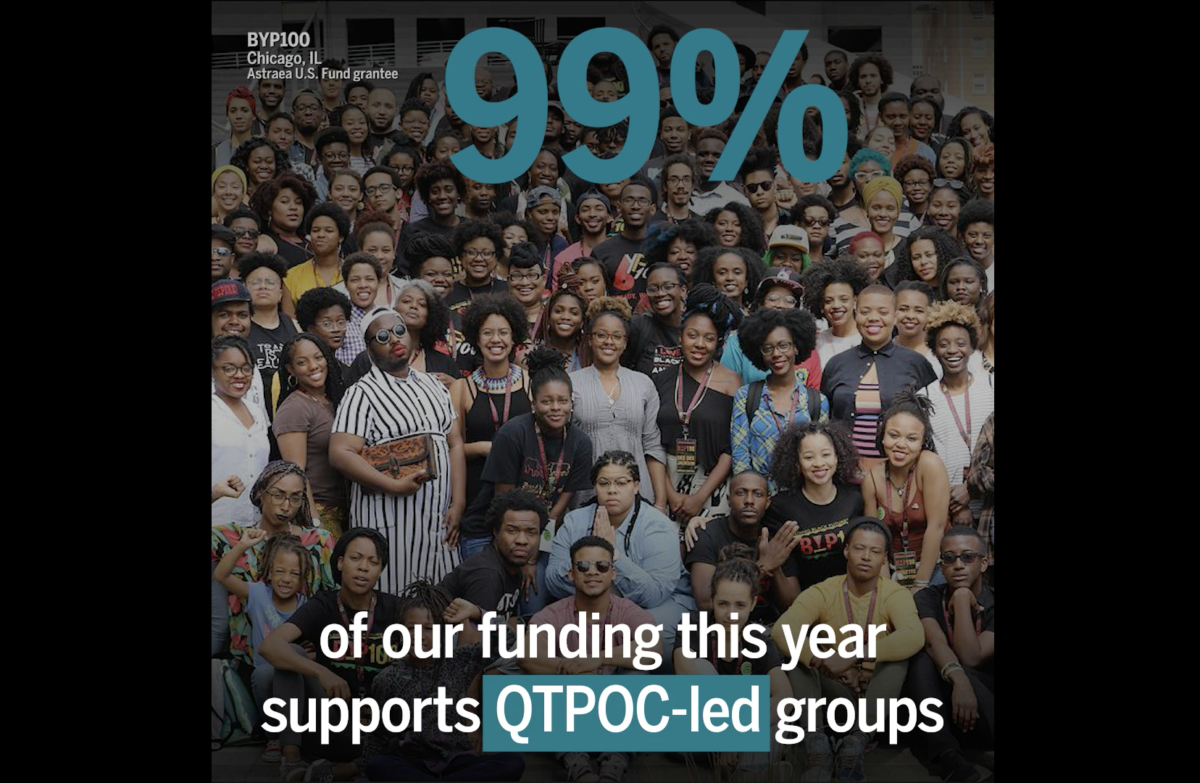
Many of our grantees are part of the Movement for Black Lives – including Law for Black Lives, BYP100, MediaJustice, Solutions Not Punishment Collaborative, and others – which has been a critical platform for Black-led groups of all sizes to really build together towards the larger Black Lives Matter agenda. 

Groups that have not been part of established platforms or coalitions in the past are also coming together to work with others who have similar goals. One such partnership is the work that grantees Black and Pink and TGIJP are doing together to support queer and trans Black people in prisons who are at extremely high risk of being infected by COVID-19. Additionally, with TGIJP leading, the groups have been working to specifically support Black trans people coming out of prison to ensure they have community support and resources during this period of social isolation, especially given that being criminalized, leaving the prison system, and reentering society already presents a number of challenges. This work of course remains incredibly necessary through the current protests and uprisings.

Fighting for access to healthcare and reproductive rights

The U.S. South – and particularly Black communities in the region – has been hit especially hard by the COVID-19 pandemic as a result of unequal access to healthcare and ill-equipped healthcare facilities. This is on top of growing attacks on abortion and trans people’s ability to access healthcare, just to name a few.

Even before the COVID-19 pandemic hit, Astraea grantees SisterSong and SPARK were working to advance reproductive justice and were often first responders for Black queer and trans communities in terms of connecting people to birthing support, doulas, and healthcare support in general. The two organizations also regularly work to create culture change, advance knowledge around reproductive justice, and build networks to improve policies and systems that negatively impact the reproductive lives and bodily autonomy of their communities. With COVID-19, the cracks in the existing healthcare system have deepened and the work of SisterSong, SPARK, and others like them has taken on even more urgency and had to expand to be able to meet their communities’ needs.

Additionally, SisterSong and SPARK have also been working in partnership with various other groups – faith-based groups, smaller rural organizations, as well as the Southeastern Alliance for Reproductive Equity (SARE), a regional partnership working to align reproductive rights, health, and justice organizations serving diverse communities in the Southeast. The work and collaboration of these coalitions has doubled down during this period, given that individual groups’ capacity is stretched but the need for their advocacy is more critical than ever.

Prioritizing Healing Justice

COVID-19 and the recent uprisings have highlighted the need for Black and Brown communities to be able to access healing justice tools and practices as essential to their survival and health. Astraea grantee National Queer and Trans Therapists of Color Network (NQTTCN) has been working both to increases their communities’ access to healers across the country, as well as to create spaces to ensure that healers themselves have access to the support systems and tools they need to be able to sustain their work. Throughout the uprisings, NQTTCN has also been using its own platforms to amplify the work of Black mental health and healing justice practitioners.

Moving beyond this ‘moment of crisis’

In Intersections of Justice in the Time of Coronavirus Cara Page & Eesha Pandit write, “As we increasingly hear the word “crisis,” which evokes panic and a fear-based response, this is an opportunity to be clear and intentional about exactly what the crisis is. In fact, though we are indeed facing a public health crisis in the form of a virus, many of our communities live in crisis and economic disparities constantly. These crises, such as lack of access to dignified and quality health care and housing, a living wage, electricity, running water and freedom from state, communal, and interpersonal violence, are created and sustained by institutions and social structures that are working as intended.”

Black queer and trans communities in the United States live in a constant state of crisis and economic disparities as a result of ongoing state-led violence and discrimination. The grassroots, community-centered collective care work of Black-led organizations is not at all new, but as crises further marginalize these communities, the urgent need to resource it and sustain it only grows. 

Ultimately however, as Cara and Eesha write, it’s about moving beyond the panic and fear of just this moment. We have to recognize that the work of Black-led organizations is an absolutely critical, galvanizing force for seeding transformative change, and we have to resource it. If we want to see that change, that transformation, and those abolitionist visions come to life, we must fund the work of Black activists, and support them to build power not just now, but forever.

Donate to Astraea now and support the incredible Black queer and trans-led organizing working to secure a more just future for us all.

***

Want to read more from our Collective Care Blog? Follow us on Facebook, Twitter, or Instagram to stay up-to-date on the latest posts!

On learning, healing, and standing up for Black lives

In this week’s blog post, we’re sharing: healing resources for Black communities and political education resources on Black and queer liberation for the moment. We’re listening to and uplifting meaningful ways to collectively care for our Black communities.

Astraea’s blog, Collective Care Blog: Building the Power & Resilience of LBTQI Movements Now & for the Long Haul, is Astraea’s response to the global COVID-19 pandemic. As a feminist LBTQI funder, we believe it is our responsibility to shed light on the ways our communities are particularly impacted by the crisis, share insights around the criticality of healing justice and collective care, as well as the ways in which we’re digging deep to keep shifting power to the grassroots in meaningful and sustainable ways.

***

On Tuesday, we issued a statement supporting the anti-racist resistance taking place in the United States and around the world right now, and condemning racism, white supremacy, policing, transphobia, and state violence that would have Black people erased. As a queer feminist funder based in the United States, we owe our existence to the civil and human rights activism of the Black, Indigenous, People of Color, trans, and queer movements that have come before us. We are reminded this June that Pride itself began as a riot against policing led by trans women of color, for our collective liberation. These are our foundations, the legacy on which we build to ensure Black liberation, and indeed the liberation of all peoples and the healing of our planet. 

In this week’s blog post, we’re sharing: healing resources for Black communities and political education resources on Black and queer liberation for the moment. We’re listening to and uplifting meaningful ways to collectively care for our Black communities. 

Some of these resources are for non-Black people and uplift the importance of anti-racism, abolition, intersectionality, and inter-community solidarity – tools and strategies we collectively need to lean into if we are to dismantle deeply embedded systems of white supremacy.

At the same time, it is absolutely necessary that Black folks have the opportunity and access to resources to be able to rest, heal, and grieve as state-sanctioned anti-Black violence continues. 

In that spirit, we’re delving into and delighted by some powerful reading on the interconnected struggles for Black and queer liberation in this moment, and healing resources that we hope are helpful to members of the Astraea community. This is by no means an exhaustive list, and we encourage you to seek out other important anti-racism resources as well. We share these as one act of care and hope that if you find them helpful, you will pass them and others on to your own communities. 

Essential reading on Black and queer liberation in this moment

  1. Demarginalizing the Intersection of Race and Sex: A Black Feminist Critique of Antidiscrimination Doctrine, Feminist Theory and Antiracist Politics – Kimberle Crenshaw 
  2. Racism is exhausting Black people. Here’s what we need. – Derrick Clifton
  3. How to Support Black Trans People Right Now – Jael Goldfine
  4. Mother Jones: The Police Killing you Probably Didn’t Hear About this Week – Laura Thompson
  5. Black Trans Men Face a Constant Threat of Police Violence – Ash Stephens
  6. Black LGBTQ+ Leaders and Allies Address the Rage Against Racism – Advocate.com Editors
  7. Queering Prison Abolition, Now? – Eric A. Stanley, Dean Spade, and Queer (In)Justice
  8. 26 Ways to be in the Struggle Beyond the Streets
  9. Black and Asian American Feminist Solidarities: A Reading List – Black Women Radicals and the Asian American Feminist Collective
  10. Of course There are Protests. The State is Failing Black People – Keeanga-Yamahtta Taylor
  11. Pride is and Always Was About Rebellion, This Year More than Ever – George M. Johnson

Healing resources for Black communities

  1. Healing Offers – Harriet’s Apothecary
  2. Rest for Resistance – QTPoC Mental Health
  3. Talking Back – bell hooks
  4. 7 Virtual Mental Health Resources Supporting Black People Right Now – Jesse Sparks
  5. 10 Wellness Resources and Relief Funds for Black individuals to find some respite – Kells McPhillips 
  6. Circle of Mothers: Trayvon Martin Foundation
  7. The Well
  8. Healing Packet – Women of Color in Solidarity
  9. National Queer and Trans Therapists of Color Network
  10. Healing Resources for BIPOC Organizers & Allies Taking Action for Black Lives – Irresistible

***

Want to read more from our Collective Care Blog? Follow us on Facebook, Twitter, or Instagram to stay up-to-date on the latest posts!

Collectively caring through resource sharing

This week, we are encouraging folks to center themselves in community to help guide us through this moment. This post includes some collective care resources from movement leaders and healing justice practitioners that have moved us in the past few months.

Astraea’s blog, Collective Care Blog: Building the Power & Resilience of LBTQI Movements Now & for the Long Haul, is Astraea’s response to the global COVID-19 pandemic. As a feminist LBTQI funder, we believe it is our responsibility to shed light on the ways our communities are particularly impacted by the crisis, share insights around the criticality of healing justice and collective care, as well as the ways in which we’re digging deep to keep shifting power to the grassroots in meaningful and sustainable ways.

***

by Sabrina Rich, Communications Team

As a queer feminist foundation that has been around for over four decades, we know what it is that allows us to survive, thrive, and heal: being in community.

As the impacts of COVID-19 continue to take a toll on our bodies, our psyches, and our everyday lives, we’re reflecting on what it means to truly stand in those communities. This post is an offering in that service. In these uncertain times, we know that caring for community—neighbors, friends, chosen family, and ourselves—is vital and necessary for supporting our collective healing. 

To quote our Healing Justice Report,

 “Over the last decade, we at Astraea have witnessed and been moved by the emergence and rise of healing justice work—resiliency and survival practices that center the collective safety and wellbeing of communities—as an integral part of our fight for collective liberation. We have learned from our grantee partners how these practices and traditions can be tools for building power, and how they can deepen and sustain the long and hard work of movement-building. Rooted in their wisdom, we continue to work to integrate healing justice as a core aspect of our grantmaking and accompaniment to organizations and movements, both in the U.S. and globally.” 

In that spirit, we’re uplifting some powerful healing justice resources that have moved us recently for their social justice and community focused approaches to healing. These resources come from movement leaders and healing justice practitioners who have and continue to prioritize collective care as integral to our freedom, and to achieving justice for all. We hope they will be helpful to you and your communities as you seek to find ways through this moment and beyond.

Some highlights!

Healing Justice Resources:

***

Want to read more from our Collective Care Blog? Follow us on Facebook, Twitter, or Instagram to stay up-to-date on the latest posts!

How we’re supporting our partners now and for the long haul

This week, we’re pleased to share with you Astraea’s COVID-19 Collective Care Response: Building the Power & Resilience of LBTQI Movements Now & for the Long Haul. This response to the pandemic aims to bolster our grantee partners now and for the long haul as they care for their communities and confront the pandemic’s impacts across the globe.

Astraea’s blog, Collective Care Blog: Building the Power & Resilience of LBTQI Movements Now & for the Long Haul, is Astraea’s response to the global COVID-19 pandemic. As a feminist LBTQI funder, we believe it is our responsibility to shed light on the ways our communities are particularly impacted by the crisis, share insights around the criticality of healing justice and collective care, as well as the ways in which we’re digging deep to keep shifting power to the grassroots in meaningful and sustainable ways.

***

by Astraea’s Development Team

Last week, we officially launched our blog and wrote about some of the immediate steps Astraea has taken to address the devastating impacts of the COVID-19 crisis on our grantee partners around the world. 

This week, we want to take a bigger picture approach and share with you Astraea’s COVID-19 Collective Care Response: Building the Power & Resilience of LBTQI Movements Now & for the Long Haul. We recognize that the health, economic, social, and political repercussions of the pandemic are going to stay with us for a long time to come, and we know that the communities Astraea exists to support – LBTQI, Black, brown, migrant, poor and working class – will continue to be those hardest hit by COVID-19. Astraea’s response aims to bolster our grantee partners now and for the long haul as they care for their communities and confront the pandemic’s impacts across the globe.

In Guayaquil, a city in Ecuador that lacks the public health infrastructure to handle its extensive COVID-19 outbreak, Astraea grantee partner Mujer y Mujer is providing food and money to sex workers, LGBTQI people, survivors of gender-based violence and individuals with limited mobility. In the U.S., grantee Southern Vision Alliance is offering financial support for coronavirus-related organizing in North and South Carolina, with priority given to efforts led by LGBTQ people, workers, youth, rural communities, Black people and people of color (POC), migrants, dis/abled people and families. In Botswana, grantee Rainbow Identity is supporting its constituents with mental health referrals and food packages. These strategies represent a massive collective care response for and by those excluded from mainstream systems. Astraea grantee partners are also continuing their advocacy to prevent further human rights violations, violence and criminalization caused by the pandemic, as well as seizing new opportunities to advance their agendas.

As a queer feminist fund that prioritizes organizations working at the intersections of multiple identities and oppressions, Astraea provides long-term, flexible, and accessible support to some of the most under-resourced communities around the world. Grounded in our Feminist Funding Principles and Healing Justice framework, we have been moved to launch our COVID-19 Collective Care Response. 

Many emergency funds have blossomed to address immediate needs, and these are an imperative part of philanthropy’s efforts. However, grassroots organizations need long-term resources to care for their people, transform their strategies to meet the moment, and bolster their resilience for now and the next ten years. Astraea’s role is to do what we have always done, but more deeply. 

In order to support our grantee partners to respond to emergent needs now and continue their critical work for years to come, Astraea’s COVID-19 Collective Care Response has two goals:

  • Raise at least $1 million from institutional and individual donors to provide increased flexible, unrestricted support for our grantee partners and build on Astraea’s close grantee accompaniment. We are glad to be halfway to that goal already. Our program team is already granting out new funds raised and as we are able to secure additional funds, we will continue to move resources to grantee partners for the short-, medium- and long-term unfolding of this crisis. 75% of the funds will be immediately regranted to our partners, with 25% resourcing Astraea’s ability to partner with movements for the long haul.
  • Amplify the importance of resourcing grassroots LBTQI and POC-led organizing, through our philanthropic advocacy and communications (including this blog!) Our communities are too often excluded from mainstream philanthropic and government responses to emergencies like this pandemic. Astraea is fiercely committed to doing all we can to center the grassroots movements who have the solutions we need to emerge from COVID-19 into a more just world. 

COVID-19 is both an unprecedented crisis and, in terms of its impacts, a foregone conclusion. Without access to sustainable, flexible resources, grassroots movements are vulnerable: when conditions change and harms increase, requiring infusions of cash and capacity, activists struggle to keep organizations open and their members safe as they try to pivot and respond. This pandemic pulls back the curtain from years of undervaluing the organizing efforts of those most impacted by dire crises. 

Astraea’s coronavirus response recognizes that now is the time for philanthropy to make good on our knowledge that long-term, flexible, general operating support and much more of it, is what our communities have long needed. Those who are closest to the problems that need addressing are best positioned to set their own priorities and determine where resources should go. 

We deeply appreciate our resource partners who have already joined our COVID-19 Collective Care Response, and we applaud those in philanthropy who are increasing flexible funding to frontline groups. As we see what it is possible for philanthropy to do when confronted with a crisis, we know that this moment is ripe for transformation. Philanthropy must move as much unrestricted funding to the ground as we can, into the hands of those who are now and will be most impacted by COVID-19 for many years to come. Join us.

***

Want to read more from our Collective Care Blog? Follow us on Facebook, Twitter, or Instagram to stay up-to-date on the latest posts!

Meeting the Moment

For Astraea’s 190+ grantee partners, the pandemic has deepened the challenges that they face, including surveillance, criminalization and violence, limited access to healthcare, economic hardship, crackdowns on civic space, and much more. This week’s blog post is a deep dive into some of the concrete steps we have already taken to amend our grantmaking process and relieve administrative burdens for grantees, so that they are able to access funding quickly and seamlessly.

Astraea’s blog, Collective Care Blog: Building the Power & Resilience of LBTQI Movements Now & for the Long Haul, is Astraea’s response to the global COVID-19 pandemic. As a feminist LBTQI funder, we believe it is our responsibility to shed light on the ways our communities are particularly impacted by the crisis, share insights around the criticality of healing justice and collective care, as well as the ways in which we’re digging deep to keep shifting power to the grassroots in meaningful and sustainable ways.

***

by Mihika Srivastava and Kyli Kleven

In the last few months, we have all watched our world change dramatically around us. For Astraea’s 190+ grantee partners, the pandemic has deepened the challenges that they face, including surveillance, criminalization and violence, limited access to healthcare, economic hardship, crackdowns on civic space, and much more. We have taken this time to reach out to our grantees all over the world, and really tune into their needs at this time. We have been learning from the ways many grantees have rapidly adapted their strategies to meet the moment, and begun to shift our own so that they continue to be determined by grantees’ priorities.

As always, our grantees and LBTQI grassroots movements at large have put their communities first by organizing in powerful and critical ways. They stand on the frontlines of the pandemic caring for their communities. For them, collective care looks like providing basic necessities, offering healing support, facilitating connections to health care, participating in mutual aid, and ensuring holistic and digital security.

As a queer feminist fund that prioritizes organizations working at the intersections of multiple identities and oppressions, Astraea provides long-term, flexible support to some of the most under-resourced communities around the world. In 2019, 75% of our funding to grantees was in the form of general operating support grants. While this moment is an unprecedented one, it calls on us as a feminist funder to commit even more deeply to these core values and practices.

“Movement building must go on and we as funders have to do our part to keep grantees resourced and financially secure. We know that both funding and other kinds of non-financial support are critical, and so it is essential that we are sending our grantees on-time payments, extending proposal and submission deadlines where needed, changing convening dates and/or moving to virtual convenings, or other new solutions that need to become practice in the weeks and months ahead,” says Astraea Interim Program Director Kerry Ashforth.

As a first step, our Program Team worked to amend our Spring 2020 grantmaking cycle to relieve grantees of as many administrative burdens as possible, and prioritize their ability to access funding quickly and seamlessly. Here are some of the steps we have taken:

  1. In March 2020, we communicated with renewal groups and waived proposal requirements for any who had not already submitted them.
  2. We have made additional funding available to existing grantees where able, and we are raising new funding to be able to do so for even more grantees going forward.
  3. We are working hard to move our current grants out more quickly, so partners are better equipped to weather the storm.
  4. Program Officers have been checking in with grantees to support with any capacity building and other accompaniment needs they may have, beyond funding.
  5. Realizing that many partners would struggle with internet access and costs, we sent offline versions of our application to as many grantees as possible. In some cases, program staff walked applicants through proposals over the phone and took notes for them.

Speaking to why it felt so critical to make these changes, our Senior Grants Manager Miabi Chatterji said, “Astraea already provides general operating support to most of our grantee partners because we believe that is the best way to support movement building. We were also already in the midst of accepting applications for our current grant cycle when the pandemic expanded globally. Our staff became incredibly aware of the need to do everything we could do to make things easier for grantee partners and try to get them their funds faster.

Above all, we are trying to use this time to question our assumptions and practices. What information do we have to collect from grantee partners, and why? What modes of communication are most accessible and genuine to grantees? What can we streamline? Can we make these practices permanent? In what ways can we create an even better future state of normal?”

We are remaining flexible and nimble in the coming weeks and months around our reporting and decision-making, particularly as we begin to plan for future grantmaking cycles. Creative solutions in grants management can often look like new metrics for tracking grantee partners’ work, or online systems for grantees to submit written materials but this moment calls for a different kind of creativity. Though many of these best practices are in place, we’re deepening and expanding our ability to weave compassion into grantmaking systems.

Throughout the coming months, we will be working to find creative solutions to these and many other questions that arise, with the ultimate goal of continuing to build power for our movements, now and over the long haul.

***

Want to read more from our Collective Care Blog? Follow us on Facebook, Twitter, or Instagram to stay up-to-date on the latest posts!